Comparative study of CNN transfer learning strategies on 101-class food image classification. Covered frozen backbone training and progressive layer-by-layer fine-tuning across GoogLeNet, MobileNetV3, and ResNet50.
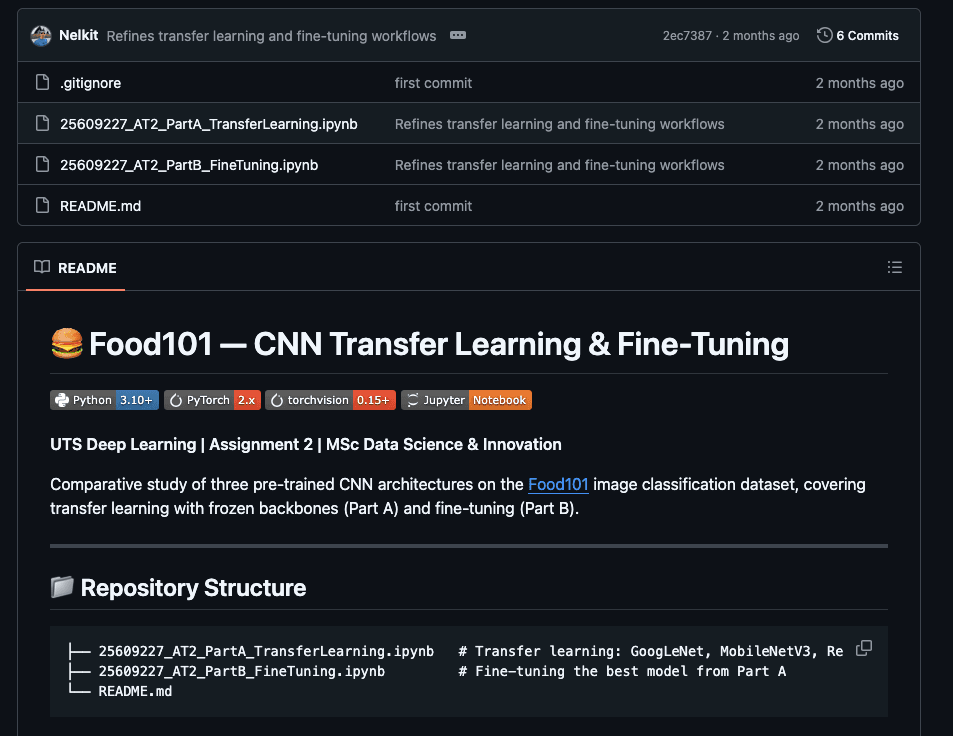
A systematic transfer learning study on the Food-101 dataset (101,000 food images across 101 categories) completed as part of the Deep Learning subject at UTS. The project evaluates three pre-trained CNN architectures under identical conditions: GoogLeNet (InceptionV1, ~7M params), ResNet50 (~25M params), and MobileNetV3-Large (~4.5M params). Part A benchmarks all three with frozen backbones and a custom three-layer classification head, finding MobileNetV3 achieves the highest Top-1 accuracy (60.27%) and Top-5 accuracy (83.88%), surpassing the original 2014 Food-101 benchmark of 50.76%. Part B applies a progressive fine-tuning strategy on MobileNetV3: Experiment 1 unfreezes the final projection block (features[-1]), boosting Top-1 to 65.94%; Experiment 2 unfreezes the last four Inverted Residual blocks (features[-4:]), achieving 72.44% Top-1 and 91.33% Top-5. Differential learning rates (1e-5 for backbone, 1e-4 for head) and dropout regularisation are applied throughout. Training ran on an NVIDIA A100 GPU via Google Colab. The report includes confusion matrix analysis of the most common misclassification pairs and an ethical review of dataset bias in food recognition systems.
