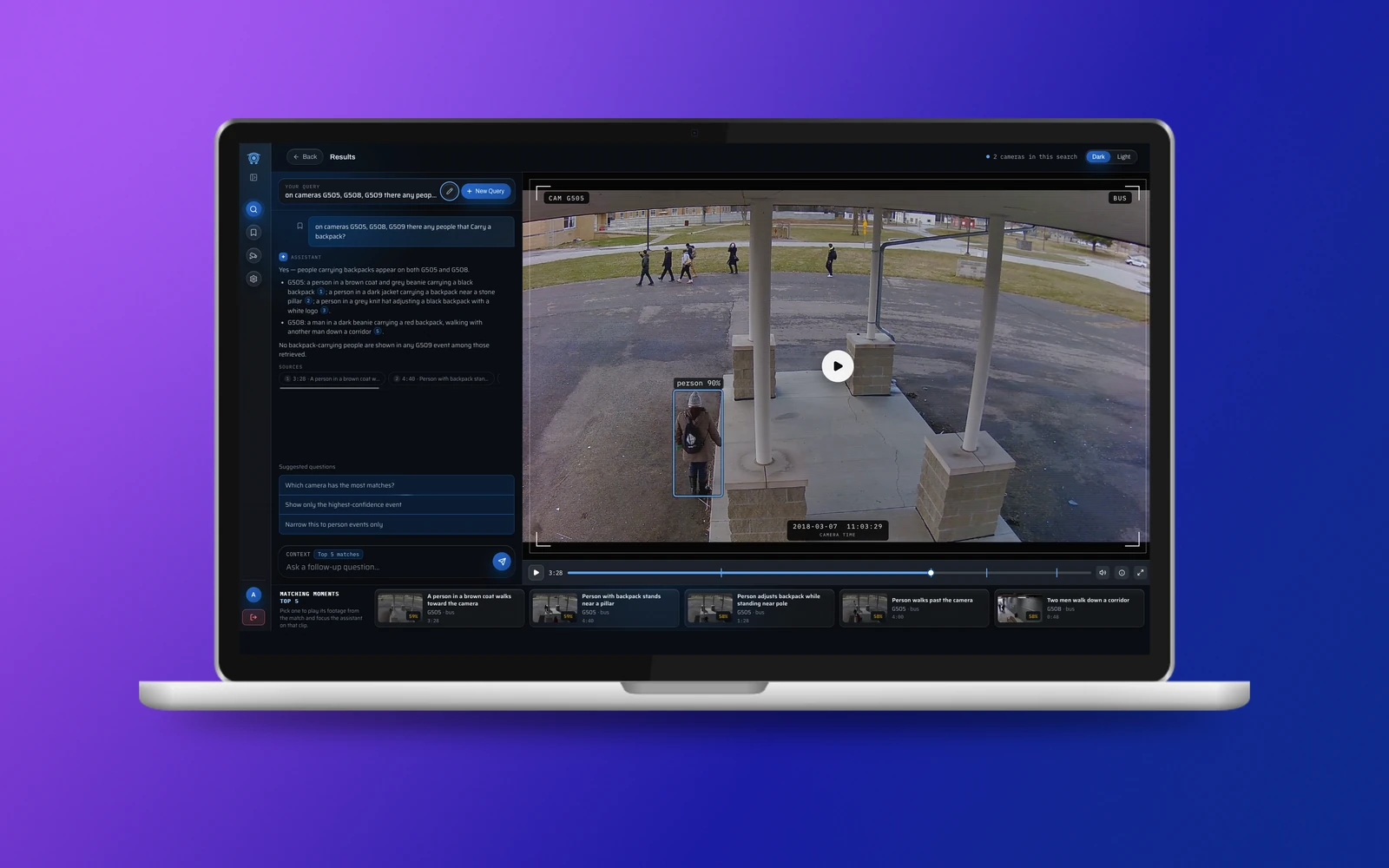
Investigators can spend hours scrubbing through CCTV footage to find one moment. Horus lets them ask instead: "What happened at the hospital on 5 March between 1pm and 2pm?" The answer comes back in plain English, and every sentence cites the moment it came from. Click a citation and the video jumps to that exact second, with the tracked people and vehicles outlined.
Built by a team of six as the capstone project of the Master of Data Science and Innovation at UTS (Spring 2026).
How it works
- Annotation pipeline. A local vision-language model (Qwen3-VL) keeps only the 10-second windows where something happens. YOLO26 with ByteTrack tracks people and vehicles, and Qwen3-VL writes each moment as a structured event with its bounding boxes.
- RAG layer. Events are embedded with
bge-base-en-v1.5 and indexed in Qdrant. Place, camera, date and time filters are pulled from each question by rule before semantic search, and an LLM writes an answer that cites every event it used.
- Backend. FastAPI verifies the user's Supabase session, runs retrieval in-process and streams search progress to the browser over Server-Sent Events.
- Web app. A Next.js interface for searching, reading cited answers and playing clips with the tracked objects drawn over the video.
Results
- 71 clips from the MEVA dataset (about 5.9 hours from 23 cameras at 4 sites) turned into 1,955 events, 1,387 tracked objects and 590,055 per-frame boxes
- Metadata filtering raised top-1 retrieval accuracy from 9 to 19 of 22 test questions
My role: Frontend Lead
- Designed the design system and built the landing page, sign-in, search, results workspace and conversational assistant
- Made the query field highlight the places, cameras, dates and times it recognises while you type, so you can see which filters will apply before any model runs
- Defined the API contract with the backend, handled integration and deployed the app on Vercel
- Created the showcase poster and the demo video (Remotion)
- Wrote tests with Vitest and Playwright