End-to-end NLP analysis of 299 public submissions to the Australian parliamentary inquiry into the 2025 federal election, investigating the perceived relationship between digital misinformation and electoral intimidation across different submitter types.
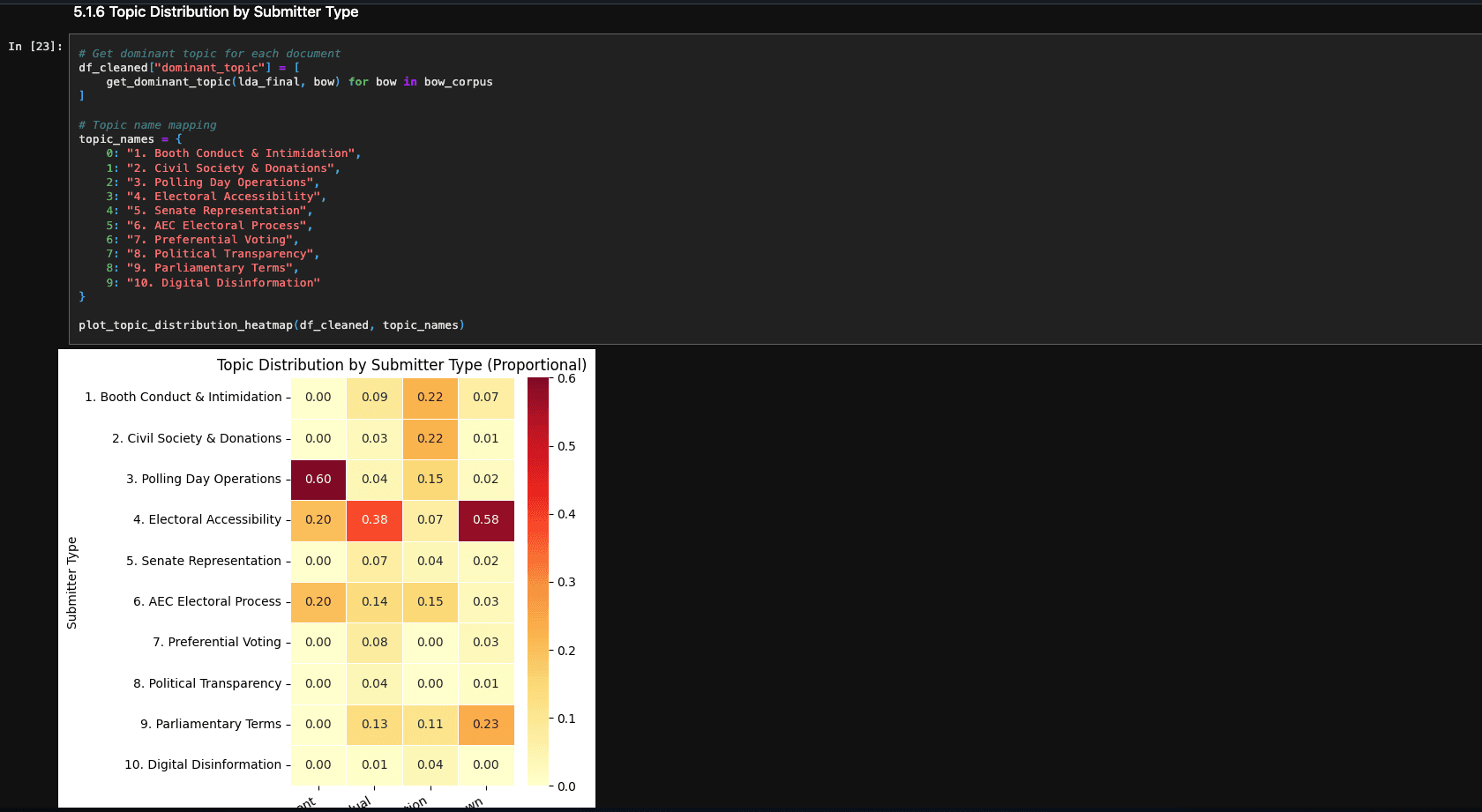
Built for the Applied NLP subject at UTS, this project implements a full NLP pipeline from scratch on 299 PDF submissions to the Joint Standing Committee on Electoral Matters (JSCEM) inquiry into the 2025 Australian federal election. The pipeline covers automated PDF extraction with OCR fallback (PyMuPDF + pytesseract), custom text preprocessing and lemmatisation with domain-specific stopwords, word frequency analysis and PMI-scored bigram and trigram extraction segmented by submitter type, LDA topic modelling with coherence scoring across k=3 to 15 (final model k=10), custom Named Entity Recognition using spaCy PhraseMatcher across six entity categories (platforms, parties, media, electoral bodies, legislation, AI tech), and VADER sentiment analysis with violin plot distributions.
Key findings: anonymous submitters showed the most negative and bimodal sentiment (mean 0.29, SD 0.86) and concentrated on electoral accessibility; intimidation-related trigrams appeared exclusively in individual submissions; the AEC was the most referenced entity across all groups; and digital platforms were largely absent from named entity references despite appearing frequently in bigrams, revealing a gap between where misinformation is experienced and where it is formally named.
